
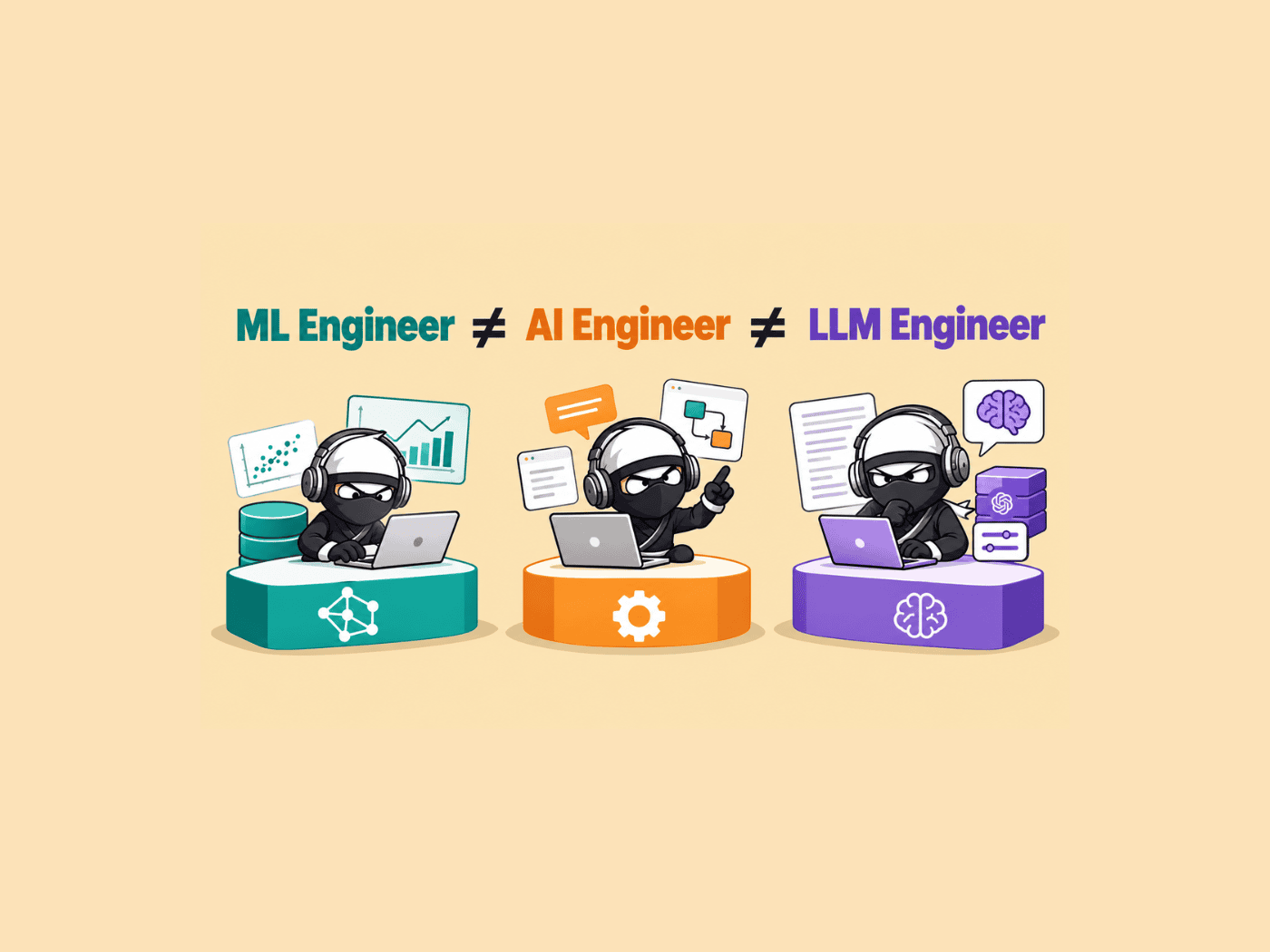
ML Engineer vs. AI Engineer vs. LLM Engineer: What Each Role Actually Builds
The same list of responsibilities shows up under four different job titles. A posting for an AI Engineer asks for Python, an API key, retrieval, and “production reliability.” So does a posting for an LLM Engineer. So does one for a Machine Learning Engineer. So does one for an MLOps Engineer. Candidates pick a career path based on the title, then discover the job description underneath describes something else entirely.
The titles are not useless, but they are unreliable. The more dependable signal is what the role actually builds. Read closely enough and the four labels collapse into three distinct kinds of work: training a model from data, wrapping someone else’s model in a product, or fine-tuning a language model after ruling fine-tuning out.
The Machine Learning Engineer: building a model from data
The Machine Learning Engineer owns the full loop. Collect and clean data, choose an algorithm, train, validate against metrics, deploy, then monitor and retrain as new data arrives. The validation step looks different depending on the task: a regression model predicting a continuous quantity is judged on error metrics such as RMSE, while a classification model sorting inputs into categories is judged on a confusion matrix. The role takes a validated approach from a data scientist and turns it into something that runs reliably in production, at scale, on data it has never seen.
The toolchain reflects that lifecycle: Python, PyTorch or TensorFlow, scikit-learn, and a feature store such as Amazon SageMaker or Databricks. Typical outputs are recommendation systems, fraud detection models, and demand forecasts. If a fraud score is attached to every transaction, an ML Engineer probably built the thing that produces it.
The title sounds like research. The work is closer to applied data science and software engineering. That distinction matters more than any job posting admits.
Where ML Engineers actually spend their time
Almost none of the job is algorithms. Most of it is data.
Bad grain, leaked labels, or a poorly designed feature window will break a model long before the choice between gradient boosting and a neural network does. A feature window that accidentally includes information from the future produces a model with beautiful validation scores and useless production behavior. A label that leaked into the training set produces the same outcome with less obvious symptoms. These are not exotic failure modes. They are the ordinary texture of the role.
This is why ML Engineers tend to write a lot of code that has nothing to do with machine learning: ingestion jobs, schema validation, backfill scripts, monitoring dashboards. The algorithm is a small, well-understood component inside a much larger system that has to keep working when the upstream data changes shape. Engineers who arrive expecting to spend their days reading papers tend to be surprised. Engineers who arrive expecting to spend their days on data plumbing tend to be fine.
The AI Engineer: starting after the model exists
The AI Engineer begins one step later. The model already exists, usually a large one trained by someone else and exposed through an API. The job is connecting that model to a real product: a support tool, an internal search feature, or an agent completing a multi-step task.
The day tends to split into four recurring kinds of work, based on how teams describe these roles in practice. A large chunk goes to prompt design, retrieval, and the mechanics of talking to a language model. A smaller chunk goes to evaluation and monitoring, watching for hallucinations or quality drops as prompts and models change underneath the product. Some of it is ordinary backend work on APIs and databases. The rest is prototyping and documentation for other teams. The exact proportions vary by team, but the categories show up almost everywhere.
The toolkit follows the work. Python or TypeScript, with LangChain, LangGraph, or LlamaIndex handling orchestration, and a vector database such as Pinecone or Qdrant for retrieval.
Nobody in this role trains a model from scratch. The work starts after a model has been trained and validated, and ends when it reliably serves real users rather than one impressive demo. The gap between those two states is where the job lives.
That gap produces the most common expectation-versus-reality complaint in the field: people take the job expecting to train models, then spend most of their time fixing data pipelines and rewriting prompts. The role is closer to product engineering with an unusual dependency than to machine learning research.
For a fuller picture of the day-to-day surface area, including embeddings, retrieval-augmented generation, agents, evaluation systems, model serving, and deployment, see 5 Free Courses to Learn AI Engineering in 2026: From LLM Basics to Production Systems.
The LLM Engineer: a narrower scope, one extra responsibility
The LLM Engineer is a narrower version of the AI Engineer, scoped to language models rather than AI broadly. Computer vision and recommendation systems are also AI. They are simply not language models, and the LLM Engineer does not touch them.
The added responsibility is fine-tuning: adjusting a pretrained model’s own weights for a specific use case. The standard techniques are LoRA and QLoRA, which adjust weights on a domain-specific dataset at a fraction of the cost of full fine-tuning. The usual trigger is a general-purpose model underperforming on a narrow, specialized task where the domain vocabulary or output format is unusual enough that prompting alone will not close the gap.
Ruling fine-tuning out
Here is the part that separates a competent LLM Engineer from an enthusiastic one. Good practitioners spend more effort ruling fine-tuning out than doing it.
Better retrieval, a longer prompt, or a different base model often solves the same problem for less money and with no ongoing maintenance burden. A fine-tuned model is a model you now own. It has to be re-tuned when the base model updates, versioned, evaluated, and served. A retrieval fix is a configuration change. When the two approaches reach similar quality, the retrieval fix wins on total cost almost every time, and the difference compounds over the life of the product.
Fine-tuning comes only after those cheaper options are ruled out. That ordering is not caution for its own sake. It reflects how often the expensive path turns out to have been unnecessary.
How the roles emerged, and how to choose between them
None of these categories were designed. They accreted.
Machine learning engineering split off from data science once deploying a model became a job in itself, distinct from the analysis that produced it. Generative AI then created a category that barely existed before 2023: the AI Engineer, whose defining feature is that someone else trained the model.
The practical consequence is that the title tells you less than the responsibilities do. Two postings with the same title can ask for completely different work. One wants LangChain. Another wants LoRA fine-tuning. A third wants API calls plus clean evaluation code. The requirements diverge because the underlying job diverges, and the label has not caught up.
So read the responsibilities and match them to what you actually want to build. If you want to own a model from raw data through retraining, look for the loop: data collection, training, validation metrics, deployment, monitoring. If you want to ship a product on top of a model you did not train, look for retrieval, orchestration, evaluation, and backend work. If you want to work close to model weights, look for fine-tuning, and then check how often the team actually does it rather than just listing it.
There is a second signal worth watching, and it applies across all three roles. The work is increasingly ordinary software engineering with an unusual dependency attached, which means the fundamentals carry further than the framework names. Understanding what the language already does, rather than memorizing library calls, pays off as the libraries churn; 7 Advanced Python Tricks That Use What the Language Already Promises You is a useful reminder of that. So does knowing how to build a library that behaves when an HTTP endpoint returns a 404 or a connection times out, the subject of Beyond setup.py: Five Best Practices for Building Robust Python AI Libraries.
The titles will keep multiplying. The underlying work will not. Three things are being built: a model trained from data, a product wrapped around someone else’s model, or a fine-tuned language model whose fine-tuning was probably ruled out first. Find the one you want to spend your days on, then find the posting that actually describes it.






One Comment
Comments are closed.