StudentSim: Simulating Students to Test AI Tutors Before They Reach a Classroom
What StudentSim Actually Is
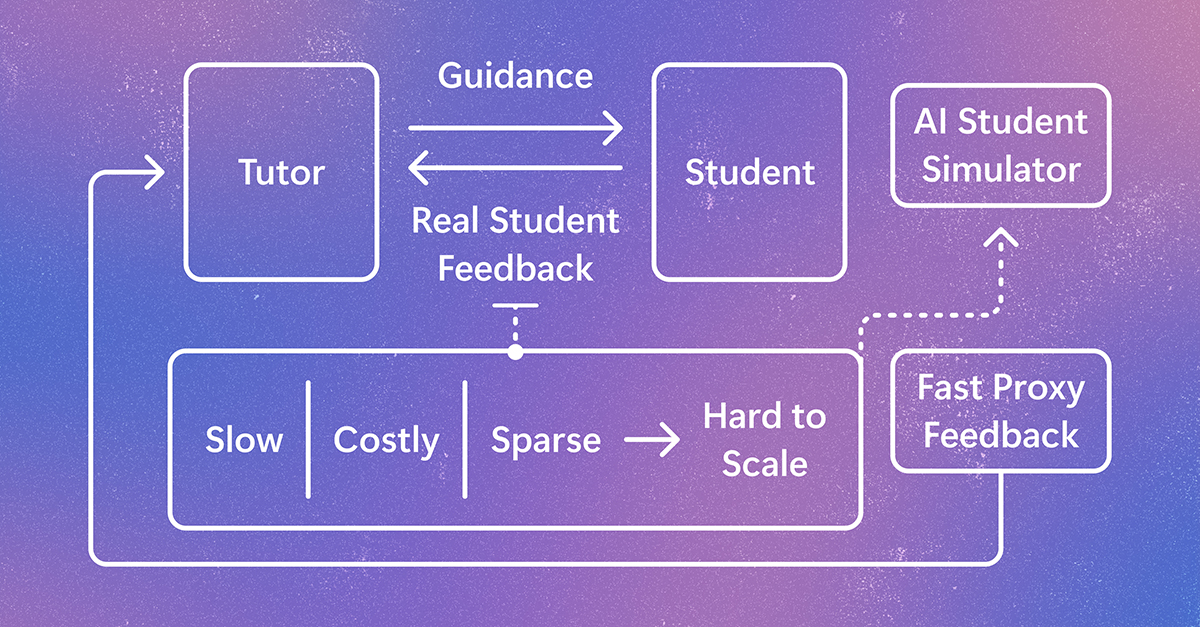
StudentSim is an AI system that creates personalized simulators of individual students. It models two things: how a given student answers questions, and how those answers change after receiving a tutor’s guidance. The goal is not to grade tutors in the abstract but to make student feedback more available while AI tutoring systems are still being built.
One caveat belongs up front, before the architecture: the available material reports no quantitative results and no publication date. The framing and the pipeline are the substance here. Treat everything below as a design description, not as evidence that the design works.
The research pairs the system with StudentSimEval, a benchmark and evaluation protocol spanning three domains with genuinely different response types:
- Chess, where the task involves predicting a player’s next move and how that player may revise after coaching.
- Second-language English writing, where the simulator generates essays with error patterns matching a learner and predicts corrections after teaching.
- Mathematics, a domain the available material describes only in general terms. What is missing is basic and specific: grade level, problem type, and answer format. Without those, the math domain cannot be compared like for like with the other two, and that gap is worth stating once rather than circling.
The three domains are a deliberate spread. A next move in chess, a grammatical correction in an essay, and a worked solution in math are not the same kind of output, and a simulator that handles all three is doing more than pattern-matching on prose.
Why Role-Playing a Student Isn’t Enough
The obvious shortcut is to ask a large language model to pretend. Give it a prompt like “You are an elementary-school student who struggles with math” and it will happily comply, adjusting its tone and expressing uncertainty in ways that read convincingly.
The problem is the ability boundary. A role-playing model may speak in a young student’s voice while relying on knowledge and reasoning far beyond that student’s level. For tutor training, that produces misleading feedback: the tutor looks effective because the simulated student is too capable. The simulation flatters the system it is supposed to test.
Existing student modeling runs into the opposite constraint. Knowledge tracing and behavior prediction methods are grounded in real learning records and can estimate a student’s current knowledge, skills, and learning habits. But many such models were not designed to accept natural-language tutor guidance as input. They can describe what a student has done. They cannot always say how that student would respond to a particular explanation, hint, or Socratic question.
That leaves a gap between two imperfect options: a simulator with the right voice and the wrong brain, or one with the right records and no way to react to teaching. Neither failure mode is exotic. A simulator tuned on one school’s records will misread a student from a different curriculum, the same distribution shift that breaks any model when the deployment population stops resembling the training one.
The Two Evaluation Goals
StudentSim defines its target through two complementary dimensions, drawing on education research and specifically on Vygotsky’s zone of proximal development, the gap between what a learner can do independently and what they can do with guidance.
Behavioral fidelity asks whether a simulator matches a specific student’s recorded responses on held-out problems. Guidance responsiveness asks whether the simulator updates its response after reading tutor guidance.
Neither signal is sufficient alone, and the research is explicit about why. A simulator that only matches past behavior may be useful for prediction, but it says nothing about whether an intervention helped. A simulator that always follows the tutor may respond fluently while failing to represent a particular student’s strengths, weaknesses, and likely mistakes. Training an AI tutor needs both: where the learner is starting from, and how guidance moves them. That is the tension the benchmark exists to measure, and it is the one to keep in mind for the rest of this piece.
The Two-Stage Training Pipeline
Individual student data is sparse. A learner may contribute only a small number of essays, answers, or interactions, and training a separate simulator from scratch for each one would risk overfitting while forcing every model to relearn the same domain patterns.
StudentSim addresses this with a two-stage pipeline. First, the model trains on records pooled across many students in the same domain, learning common response formats, common errors, and common ways students revise after guidance. Second, it specializes on one student’s own records to produce the personalized simulator.
The design is a familiar one in machine learning: learn the general structure from the population, then adapt to the individual. What makes it interesting here is that the adaptation target is not a style or a topic but a learner’s specific error profile and their particular way of responding to help.
Data and Privacy
The privacy posture is narrow by design. The research uses only publicly available learner datasets released for research use with de-identified records, and no personally identifying information is used at any stage. Each personalized simulator is trained only on the de-identified records of the student it represents.
That constraint matters for how the work should be read. These are simulators of students who consented, through whatever process governed the original dataset release, to have their de-identified work used for research. They are not general-purpose models of “a struggling learner,” and the research does not present them as such.
Scope and Caveats
StudentSim is an R&D evaluation tool. The stated goal is not to replace teachers or classroom learning, and the framing is deliberately modest: help researchers evaluate and improve AI tutoring systems during development, before testing with real learners. A simulator that performs well on a benchmark is a hypothesis about a student, not a substitute for one.
As noted above, the research reports no quantitative results and no publication date, so the architecture and evaluation framing are the substance here. Wait for the numbers before drawing conclusions about how well any of it works.
What to Watch
The open question is transfer. Chess, second-language writing, and mathematics are three very different response types, and benchmark performance in each is only a proxy for the thing that matters: whether a tutor that improves against a simulated student also improves outcomes for a real one.
Watch for two things. First, whether the benchmark results, once published, show that behavioral fidelity and guidance responsiveness can be optimized together rather than trading off against each other. Second, whether simulated feedback earns a place in the AI tutor development loop at all. If it does, the practical effect is a shorter path from a model change to a signal about whether that change helped a learner, which is exactly the kind of iteration speed that student studies, for all their value, have never been able to provide.