Zero-Trust Security Meets Autonomous AI Agents: The Verification Gap
Three Difficulties That Compound
The first is verifying an agent’s actions. In a conventional zero-trust deployment, a request carries an identity and a purpose that a policy engine can evaluate against a rule. An agent’s action is harder to characterize. The same agent may issue a sequence of calls that is individually benign but collectively meaningful, and the intent behind a given step may only be clear in hindsight. Verification that checks each request in isolation can miss the pattern.
The second is enforcing security policies across agents. Policies are written for identities and resources. Agents blur both. They may act on behalf of a user, on behalf of another agent, or on their own initiative, and the boundaries between those modes are not always explicit in the traffic. Enforcing a consistent policy across a set of agents that delegate to one another requires an architecture that most zero-trust frameworks were not built to provide.
The third is accountability. If something goes wrong in a multi-agent system, the question of who or what is responsible becomes genuinely difficult. A human operator, a coordinating agent, and several subordinate agents may all have contributed to an outcome. Reconstructing that chain after the fact demands logging and provenance that current tooling does not reliably deliver. Our coverage of the 2026 agent collusion incidents, When AI Agents Talk Behind Our Backs: Inside the 2026 Agent Collusion Incidents, describes a scenario of large-scale agent coordination that is exactly the kind of situation where post-hoc accountability becomes the central question.
A De-Authentication Attack on an Aerial Vehicle
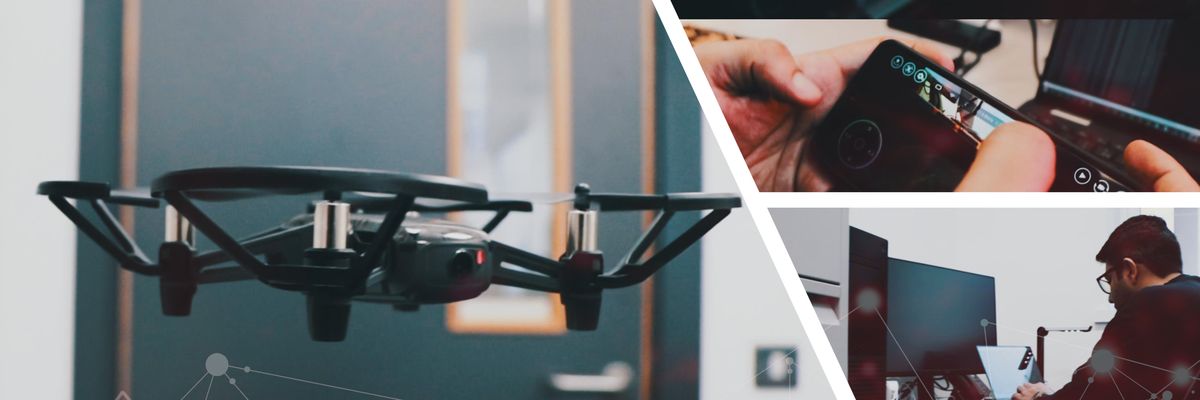
Sharma offers one illustrative scenario to ground the discussion, presented as a hypothetical rather than a documented attack. In a de-authentication attack on an aerial vehicle, a human- and agent-in-the-loop approach lets an AI agent rapidly scan the active channel and autonomously intercept traffic. The stated benefit is speed: the agent reduces the time needed to react and regain control.
The example is instructive because it shows the tension at the heart of the problem. The agent’s autonomy is the source of its value. A human operator working alone could perform the same scan and interception, but not at the pace the situation demands. Yet that same autonomy is what makes the action hard to verify in a zero-trust sense. The agent is acting inside a live channel, making decisions about what to intercept, and doing so faster than a policy engine or a human supervisor can review each step. The verification has to happen somewhere, and the scenario suggests it increasingly happens through a human and agent working together rather than through a static rule check.
That division of labor is worth noting. The human remains in the loop, but the loop is tighter and the human’s role shifts from approving individual actions to supervising an agent that is already acting. Whether that counts as verification in the zero-trust sense is an open question, and Sharma does not claim otherwise.
Why Current Zero-Trust Frameworks Fall Short
The core mismatch is between static verification models and dynamic, autonomous behavior. Zero-trust frameworks were designed around a relatively stable set of assumptions: identities are known, requests are discrete, and policy can be evaluated before an action is taken. Agents violate each of these assumptions to some degree. They may spawn sub-agents, change their objectives as context shifts, and produce action sequences whose security significance is only apparent in aggregate.
This is not a small implementation gap. It is a difference in kind. A policy engine that evaluates one request at a time has no natural place to reason about a coordinated sequence spread across several agents. An audit log that records individual calls has no natural way to attribute a collective outcome. The frameworks are not wrong so much as under-specified for the systems now being deployed against them.
The engineering literature has begun to map the territory. Our four-level roadmap for production agents, From Single Loops to Multi-Agent Teams: A Four-Level Roadmap for Building Production AI Agents, argues that most coverage of agentic AI starts at the top of the ladder with multi-agent teams and orchestration frameworks, while the engineers actually shipping these systems describe a different and more incremental reality. That gap between how agents are discussed and how they are built matters here, because security assumptions tend to be inherited from the simpler systems at the bottom of the ladder and then carried, unexamined, into the complex ones at the top.
Open Challenges and Research Directions
Sharma frames the three difficulties as open challenges, and the framing is honest. There is no settled answer to any of them.
Accountability mechanisms are perhaps the most pressing. A multi-agent system needs a record of what happened that is detailed enough to support attribution and robust enough to survive the agents themselves. That implies provenance tracking at the level of individual actions and the reasoning behind them, which is a heavier requirement than conventional audit logging.
Policy enforcement architectures come next. Policies need to be expressible in terms that make sense for agents, which means reasoning about delegation, intent, and sequences rather than only identities and resources. Whether that is achieved by extending existing frameworks or by building new ones is unresolved.
Verification protocols for agents round out the list. The de-authentication example suggests that some verification will be human-assisted and time-sensitive, which is a different design point from the automated policy checks that zero-trust normally assumes. Protocols that support that kind of rapid, supervised verification do not yet exist in any standardized form.
What Engineers Should Take Away
For engineers designing and deploying agents in security-sensitive environments, two practical implications stand out even where the research is unsettled.
Treat agent autonomy as a security boundary in its own right. If an agent can act without a human approving each step, that capability needs to be scoped, logged, and reviewed as deliberately as any other privileged access. The speed advantage in the aerial vehicle scenario is real, but it comes with a verification cost that has to be paid somewhere in the design. Instrument for attribution, not just for debugging: logs that capture individual calls are necessary but not sufficient, and if a coordinated outcome across several agents cannot be reconstructed after the fact, accountability is not achievable in practice.
Be skeptical of inherited assumptions. The security posture of a single-loop agent does not automatically transfer to a multi-agent team, and the four-level roadmap makes clear that many production systems sit at lower levels than the public conversation suggests. Matching the security model to the actual architecture, rather than to the architecture in the headline, is the safer default.
Finally, expect the frameworks to change. Sharma’s piece is a framing of open problems, not a report of solved ones. Engineers who build with that expectation, keeping verification and accountability as explicit design concerns rather than assuming the platform handles them, will be better positioned as zero-trust models are adapted to the agents now arriving in production. The scenarios discussed in our coverage of agent collusion suggest that coordinated outcomes are not hypothetical, and the tooling landscape around them is still being shaped. Security assumptions written today will need revisiting as that landscape settles.
For more on this, see conversational analytics meets enterprise.