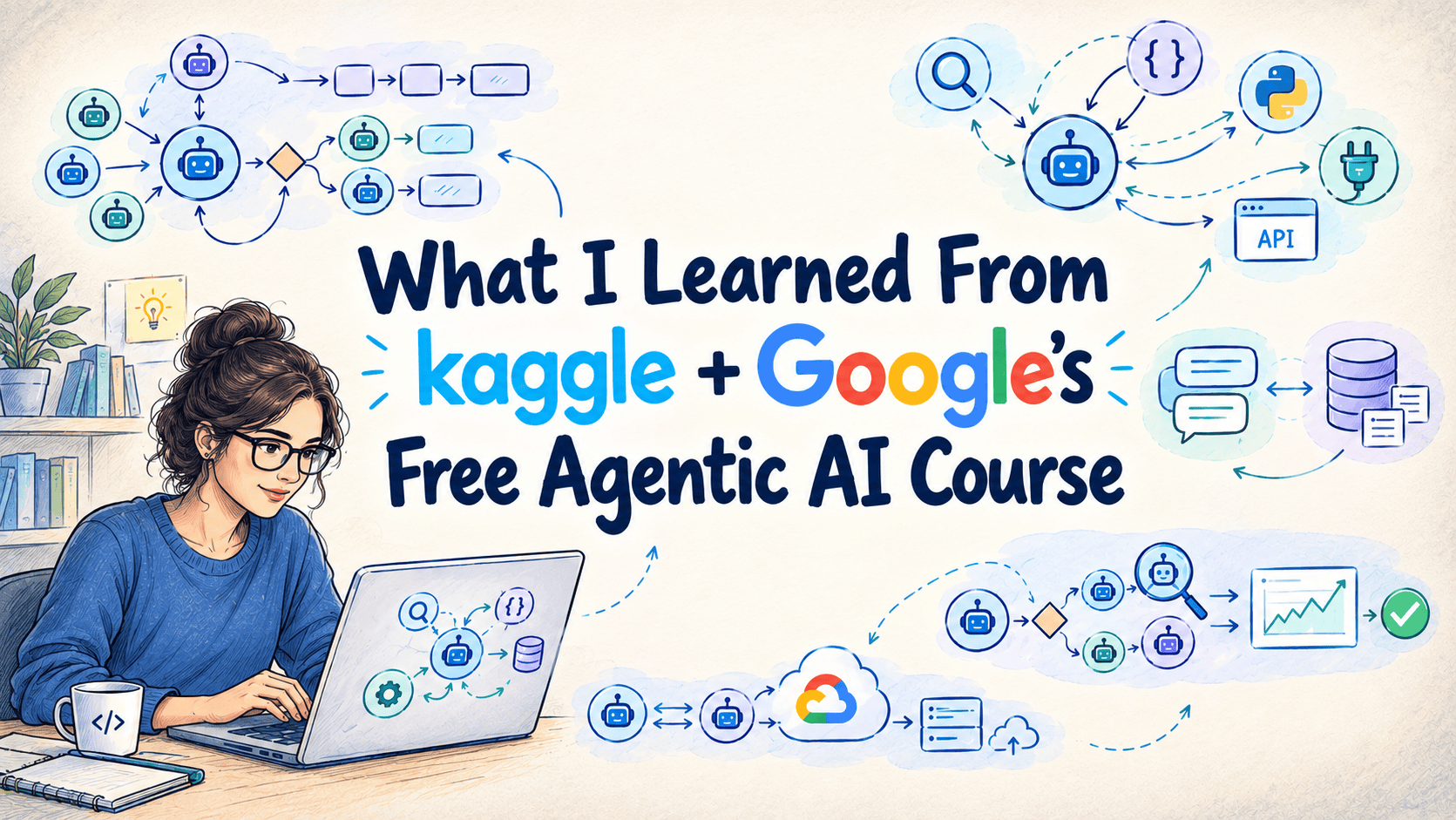
Google and Kaggle’s Free AI Agents Course: What Engineers Actually Learn
Most free AI courses are a video and a Colab notebook that stops working six months later. The 5-Day AI Agents Intensive from Kaggle and Google is a different animal. It ran live from 10 to 14 November 2025, and rather than evaporating when the livestream ended, it now sits on Kaggle as a free, self-paced program with whitepapers, hands-on codelabs, podcasts and the recorded sessions.
The prerequisites are refreshingly honest: Python and some experience calling an LLM API. No prior agent knowledge required. Each day pairs one whitepaper with two hands-on notebooks built on Gemini and the Agent Development Kit (ADK), Google’s open-source agent framework.
At a glance:
- Free, self-paced, hosted on Kaggle (a Kaggle account is required to access the notebooks and codelabs)
- Five days of material: one whitepaper and two hands-on notebooks per day
- Built on Gemini and ADK, with recorded sessions and companion podcasts
- Prerequisites: Python and prior experience calling an LLM API
That framing matters. The course is not a tour of Gemini features. It is a short, opinionated education in a mental model, and the model is the part that survives a change of vendor. Here is what engineers actually take away from it, day by day.
What an agent actually is
Strip away the marketing and an agent is a model in a loop. The model picks an action, calls a tool, reads the result, and decides the next step. That is the whole trick, and every architecture in the course is a variation on it.
If you have built a plain prompt-and-response application, the shift is smaller than it sounds. Where a basic LLM program sends a prompt and stops, an agent keeps the cycle turning until a condition is met. If you want a gentler on-ramp to that pattern before touching ADK, our walkthrough of the OpenAI Agents SDK covers the same loop in familiar Python.
The course frames an ADK agent as a bundle of five things: a name, a model, a description that other agents can read, instructions, and a list of tools. A runner executes it. The course draws a practical line here: an in-memory runner is fine for experiments, while production needs a persistent runner. That distinction sounds mundane until you realize it is the difference between a demo and a system that survives a restart.
Takeaway: an agent is a model in a loop, and the loop needs a runner that outlives the process.
Day 1: multi-agent architectures, and why pipelines come first
The first day covers four patterns: a parent agent choosing among sub-agents, a sequential pipeline, parallel branches, and a loop that repeats until a condition is met. In a sequential pipeline, each agent passes its output to the next.
The course’s most useful piece of advice is an ordering. Start with pipelines. A fixed order means a failure is traceable to exactly one stage, because you know which agent produced the bad output. Model-driven sub-agent selection is more flexible, but when something goes wrong you need tracing to work out which agent was even chosen. Engineers who begin with the flexible pattern spend their first week debugging routing instead of reasoning.
Takeaway: build the boring pipeline first. Flexibility is a later optimization, not a starting point.
Day 2: tools, and the docstring as prompt
Four tool types are covered: built-in tools such as Google Search, function tools that wrap Python functions, agent tools that delegate subtasks while keeping control of the conversation, and MCP tools that connect to external services over the protocol.
The detail that catches people out is how function tools get selected. The model picks from the descriptions alone. It does not read your source. That makes docstrings, type hints and structured return values load-bearing parts of the prompt, not documentation chores. Vague descriptions produce wrong calls, and the course offers a diagnostic rule worth taping to a monitor: when an agent picks the wrong tool, read the tool description before editing the prompt.
The difference is easy to see in miniature. A docstring that says """Gets data.""" tells the model almost nothing, so it will guess. A docstring that says """Returns the current weather for a city. Use when the user asks about temperature, rain or conditions. Input: city name as a string.""" gives the model a selection rule, an input contract and a reason to prefer this tool over a neighboring one. Same function, same code, wildly different routing behavior.
Day 2 also covers human approval for long-running operations, where the agent pauses for confirmation before continuing. That pause is a small feature with large implications. Once agents take consequential actions, the question of who signs off stops being a UX detail and becomes a security boundary, a theme our analysis of zero-trust verification for autonomous agents explores in depth.
Takeaway: tool descriptions are prompts. Write them for the model, not for your teammates.
Day 3: memory is a cost decision
The third day starts from an uncomfortable fact: models retain nothing between calls. Conversation history is resent every turn, and every token of it costs money.
The course splits memory in two. Short-term memory is the session, the conversation history managed by a session service. Long-term memory lives outside the session, is searched through a memory service, and persists facts across conversations. The implementation detail that matters: in-memory memory services search by keyword, while managed services can search by meaning. Semantic retrieval is a service you pay for, not a default.
Then come context compaction and caching, the levers that keep cost and context size under control as sessions grow. The design question underneath is retrieval mode. Reactive retrieval lets the agent search when it decides to, saving the cost of a search on every turn but relying on the agent to know when to look. Proactive retrieval searches before every turn and supplies the results, costing one search per turn but removing that judgment call. Neither is correct in general. The point is that memory is an architecture and budget decision, and the course treats it that way.
Takeaway: decide your retrieval mode and compaction strategy before your sessions get long, not after the bill arrives.
Day 4: quality and debugging
Agents are non-deterministic. The same input can produce different tool calls, so a final spot check before shipping proves very little.
The course’s answer is observability: logs, traces and metrics. A trace shows each step the agent took, which makes a wrong answer debuggable after the fact rather than mysterious. Concretely, a trace of a failed request shows the user prompt, the model’s chosen tool call with its arguments, the tool’s raw return value, and the model’s next step. When the answer is wrong, that sequence tells you whether the model picked the wrong tool, passed bad arguments, or reasoned correctly over a bad result, three very different bugs with three different fixes.
This is the same discipline that multi-agent systems demand at scale, and it becomes urgent once agents interact with each other unsupervised. Our report on the 2026 agent collusion incidents is a reminder of what happens when nobody can reconstruct what a swarm did.
Takeaway: if you cannot replay what the agent did, you cannot debug it. Instrument before you ship.
Who should take it, and what to watch for
The course suits engineers who can already call an LLM API and want a structured first pass at agents. It is free, self-paced, and the notebooks run against a real framework rather than pseudocode.
The honest limitation is vendor gravity. The emphasis on ADK and Gemini means the concepts transfer more readily than the code. Pipelines before swarms, tool descriptions as prompts, memory as a cost decision, traces as the only way to debug a non-deterministic system: those lessons apply whether you build on ADK, the OpenAI Agents SDK, or something you assemble yourself. The import statements will not survive a migration. The mental model will.