AI Is Giving Optical Computing Another Shot — and the Math Explains Why
Why now: inference, not training
Much of the public conversation about AI energy focuses on training runs. The operational reality is different: inference, the act of using a trained model to respond to user queries, makes up the bulk of AI energy use and has driven much of the construction of large, power-hungry data centers. Every query served is a chain of matrix-vector multiplications, repeated countless times per second across a fleet.
Peter McMahon, associate professor of applied and engineering physics at Cornell University, puts the shift plainly: “Most of the interest in [photonics] is driven by the fact that AI inference has literally become limited by power, and in a rather striking manner.”
On paper, optics promises to perform the same math as today’s GPUs at drastically lower power. That “on paper” qualifier is doing a lot of work, and we will come back to it.
The N versus N² argument
Here is the entire commercial pitch in one comparison. A matrix-vector product of size N requires N² scalar multiplications. On a GPU, each of those multiplications is an energy event, so the energy cost of the operation grows quadratically with problem size. That is why scaling models and context windows translate so directly into power bills.
In the optical version, the multiplication is passive. As long as the matrix stored in the attenuator does not change, passing light through it costs almost no energy. Energy is spent only at the edges: encoding the vector into light and reading out the result. Both of those scale with N, not N².
The gap between N and N² is what makes the field commercially interesting again. It is also where the engineering difficulty concentrates. Encoding and readout are electronic processes, and they have sunk past attempts at optical computing. The optics is cheap; the conversion between electrons and photons is not.
The 1978 blueprint that still defines the field
The canonical demonstration of how light does linear algebra dates to 1978, when optical-computing pioneer Joseph W. Goodman and coworkers proposed a matrix-vector multiplier built from lenses and light. In that design, N is the length of the input vector and the dimension of the square matrix it is multiplied by.
The setup is worth walking through because it still defines the architecture of the field:
- A row of N light-emitting diodes encodes a vector of length N into light intensity.
- A cylindrical lens spreads the light vertically, copying the vector N times.
- The light passes through an N-by-N pixel attenuator, which scales each pixel according to the corresponding matrix value. This is the multiplication.
- A second cylindrical lens, oriented perpendicular to the first, re-collects and sums the light from each row.
- A row of detectors measures the final vector.
No transistor performs a multiply. The matrix lives in the attenuator as fixed transmission values, and the vector lives in the brightness of the diodes. The optics does the rest. Decades later, related optical Fourier transform and free-space propagation techniques appear in some of the systems now attracting venture capital, such as Optalysys’s Fourier transform element.
Who is building it
Startups in several countries are pursuing approaches that range from direct competition with GPU makers such as Nvidia to complementary bets: alternative AI algorithms, scientific computing, and in-network computing.
Optalysys sits in the last category. The company inserts optical-computing elements into the networking path, where data centers already use light, and its basic on-chip optical element is a Fourier transform calculator. The logic is pragmatic: rather than replacing the GPU, put photonics where the infrastructure is already optical and the conversion overhead is lowest.
The breadth of approaches is itself a signal. When a technology’s core advantage is an asymptotic scaling argument rather than a proven product, companies hedge by attacking different parts of the stack. Some will fail. The question is whether the survivors produce results the rest of the field can reproduce.
What the researchers say
Logan Wright, assistant professor of applied physics at Yale University and a former postdoc in McMahon’s lab, argues that the value of the current wave may exceed whatever AI products come out of it. “I think it would be good for the technology if many of these companies made a good run at it,” he said. “I think that the technology that will be developed through this would be really, really useful, and enable photonic systems that maybe don’t get on this wave of AI but would be capable of doing really quite special things.”
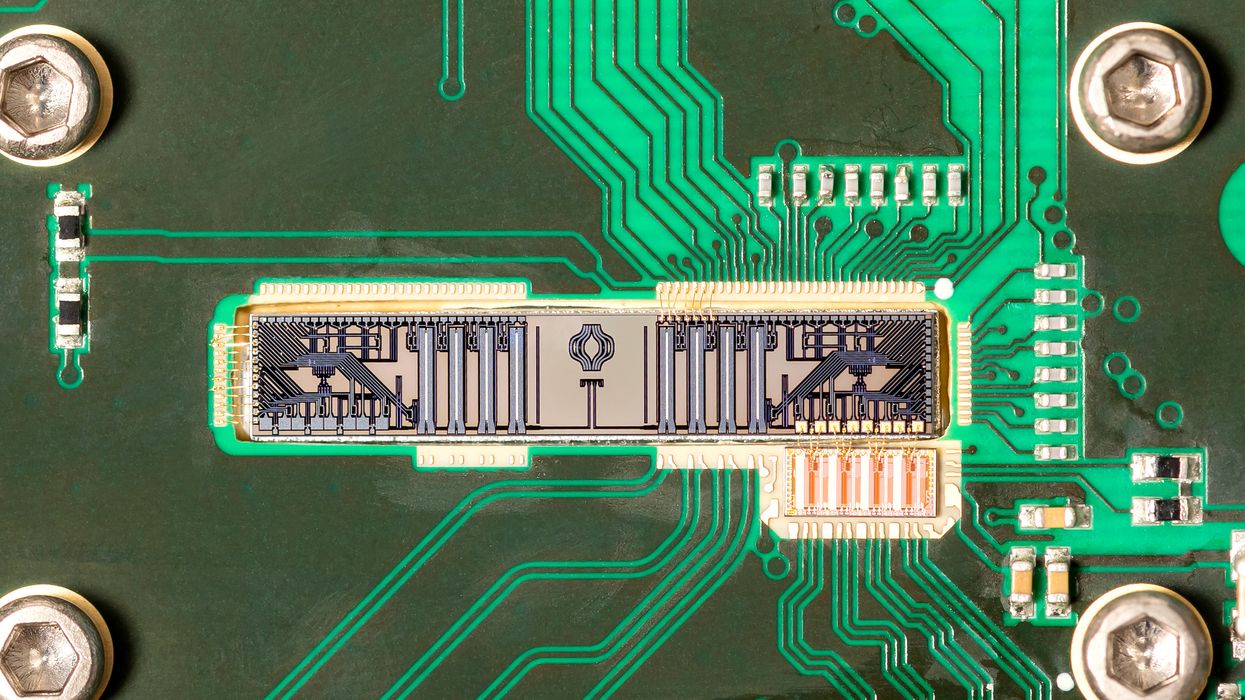
McMahon, who has researched optical computing for over a decade, frames the power limit as the core driver rather than a marketing hook. His team’s 2022 demonstration at Cornell is one data point for anyone assessing how far the engineering has actually moved, and it is the kind of result that matters more than valuation headlines. The same is true across AI research more broadly: published methods and reproducibility separate durable progress from noise, whether the subject is a photonic matrix multiplier or a new benchmark. The pattern is consistent: the headline is the easy part, and the evaluation is where the field learns whether anything real happened.
For a recent example of that evaluation-first approach outside photonics, Scientist World turns 1,000 papers into a training gym for AI researchers.
What to watch
Two questions will decide whether this optical wave ends differently from the previous ones.
The first is overhead. The N versus N² argument only wins if the cost of encoding a vector into light and reading the result back out stays small relative to the multiplication it replaces. Past attempts foundered on exactly this conversion cost, and no amount of investment changes the physics. Watch for published end-to-end energy numbers on real inference workloads, not component-level figures.
The second is reproducibility. A field that has cycled through hype before needs results that independent engineers can rebuild and verify. The 2022 Cornell demonstration is one useful reference point, but a commercial industry needs a body of reproducible work. If the current crop of startups publishes reproducible benchmarks alongside their funding announcements, the field has a foundation. If it does not, the next valuation story may look a lot like the last one.