HiPHI Dataset: 617.5 Hours of Whole-Body Motion for Humanoid Robot Training
Humanoid robots have a data problem, and it is not the kind that more compute will fix. The behaviors that make a machine useful in a warehouse, a kitchen, or a hospital are messy, varied, and physical, and the two dominant sources of training data each fail in a different direction. Internet video offers enormous behavioral diversity but no precise physical state: you can watch a human carry a box, but you cannot recover the joint torques. Laboratory motion capture delivers sub-millimeter precision but typically covers a narrow slice of actions, often a single task repeated under controlled conditions.
A new white paper sponsored by Noitom Robotics, published through IEEE Spectrum and Wiley, claims to narrow that gap. The HiPHI dataset packs 617.5 hours of whole-body human motion captured with optical motion capture, plus 245.7 hours of human-object interaction with synchronized object trajectories and meshes. The paper also reports policies trained on the data and deployed on a physical Unitree G1 humanoid. It is an ambitious pitch, and because it arrives as a sponsored white paper rather than a peer-reviewed paper, the claims are worth reading carefully.
What is actually inside HiPHI
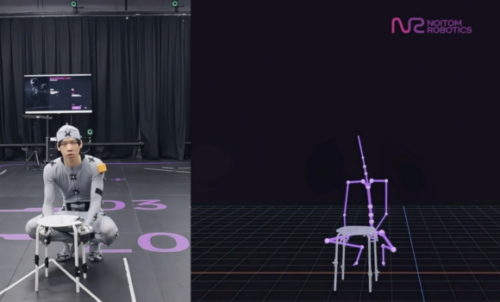
The headline numbers are straightforward. HiPHI contains 617.5 hours of whole-body human motion, captured with optical motion capture at what the paper describes as sub-millimeter accuracy. That precision figure matters because it is the property internet video cannot supply: accurate 3D joint positions and body poses over time, at a fidelity that supports physically grounded policy learning rather than approximate imitation.
Roughly 40 percent of the dataset, 245.7 hours, consists of human-object interaction. This is the part that separates HiPHI from a pure locomotion corpus. Each interaction clip comes with synchronized object trajectories and meshes, meaning the data captures not just how a person moved but where the object was, how it was oriented, and how its geometry changed relative to the body. For a robot that needs to pick up a cup, open a drawer, or hand something to a person, that pairing is the difference between learning a gesture and learning a task.
The practical question for anyone evaluating a new corpus is what the data lets a model do that it could not do before. HiPHI’s answer is that it combines scale, physical accuracy, and object awareness in one dataset, a combination that has been hard to assemble. For how that open research pipeline usually works, see Inside arXivLabs: How Open Collaboration Shapes the Infrastructure Behind AI Research.
FrameNet as an organizing principle
The most unusual design choice in HiPHI is how coverage is structured. Rather than organizing clips by activity label or capture session, the dataset uses FrameNet, a linguistic framework for describing human action. FrameNet groups language around semantic frames: a “Giving” frame, for instance, involves a donor, a recipient, and a theme, with defined roles for each participant. Applied to motion data, this becomes a way to index behaviors by what is happening semantically, not just by what the body is doing geometrically.
Why does that matter for embodied policies? Because a robot trained on raw motion alone learns to reproduce trajectories without understanding the situation that produced them. Semantic labeling gives a policy a handle on intent and context, which is exactly what generalization requires. If a model has seen many instances of the same frame with different objects, body types, and environments, it has a better chance of transferring that structure to a new situation than if it had memorized a thousand unrelated clips. FrameNet is not a new idea in natural language processing, but using it as the backbone for a motion dataset is a genuinely different approach, and it suggests the authors are thinking about policy generalization, not just data volume.
Benchmarks for motion diversity and interaction grounding
The paper also introduces a benchmark suite for measuring motion diversity and interaction grounding. This is a quieter contribution than the dataset itself, but it may prove more durable. Existing evaluations for motion datasets tend to reward either realism or coverage, rarely both, and they usually ignore objects entirely. A benchmark that scores how well a dataset grounds interaction, meaning how tightly motion is tied to object state, addresses a gap that has made cross-dataset comparison difficult.
A diversity metric tells you whether a corpus will generalize or collapse into a handful of repeated behaviors; an interaction grounding metric tells you whether the data supports manipulation tasks or only locomotion. Whether HiPHI’s benchmark suite becomes a standard or remains a self-assessment depends on adoption, which in turn depends on access.
From dataset to robot
The most consequential claim in the paper is the deployment result: policies trained on HiPHI and run on a physical Unitree G1 humanoid. The G1 is a widely used research platform (though the white paper itself does not document its prevalence), which makes the result more legible than a demo on custom hardware would be. The paper’s framing suggests that both data scale and interaction grounding contribute to performance, though the source material does not provide the detailed ablations, success rates, or failure cases that would let a reader judge how much of the gain comes from each factor.
Independent replication on the same platform, ideally with released checkpoints and evaluation scripts, is what would move this from a promising claim to a usable foundation. The same is true of the dataset itself: 617.5 hours is only valuable if engineers can actually train on it, which means clear licensing, documented formats, and tooling that does not require reverse engineering.
Caveats and open questions
Several things are conspicuously absent from the source. There is no pricing, no availability information, and no launch date for the dataset or the benchmark suite. No commercial terms or regional availability have been disclosed, so it is not yet possible to say what the data would cost or where it would be offered. Access to the white paper itself requires registering a user profile and logging in. The only hard numbers provided are the durations (617.5 hours total, 245.7 hours of interaction) and the stated sub-millimeter capture accuracy. Everything else on the source page is registration prompts, sponsor and partner descriptions, and internal topic and tag metadata.
The sponsorship matters too. Noitom Robotics describes itself as building ModalityNet, “the human-centric data substrate that makes the physical world learnable for embodied AI,” which places the company directly in the business of selling or licensing motion data. That does not make the claims false, but it does mean the paper functions partly as a product argument. The robot results should be treated as preliminary until independent groups reproduce them, and the release terms should be watched closely to see whether they permit commercial training.
What to watch next for embodied AI
If HiPHI delivers even part of what it promises, it points toward a shift in how humanoid policies get built. The field has spent years working around the scarcity of physically accurate, interaction-rich human motion; a corpus of this size, with object trajectories attached, would change the economics of training. The FrameNet layer is the more interesting bet, because it suggests that semantic structure, not just scale, is what makes motion data transferable across tasks and embodiments.
Three things will determine whether this becomes infrastructure or a footnote. First, release terms: can researchers and companies actually use the data, and at what cost? Second, replication: do independent labs reproduce the Unitree G1 results? Third, benchmark adoption: does the diversity and grounding suite get picked up by others, or does it stay internal? Until those questions are answered, HiPHI is best read as a well-specified hypothesis about what humanoid learning needs, backed by numbers that are large, precise, and still awaiting outside verification.