Vibe Coding Breakout: What Building a 1976 Classic with an AI Agent Teaches Working Engineers
What vibe coding actually means in 2026
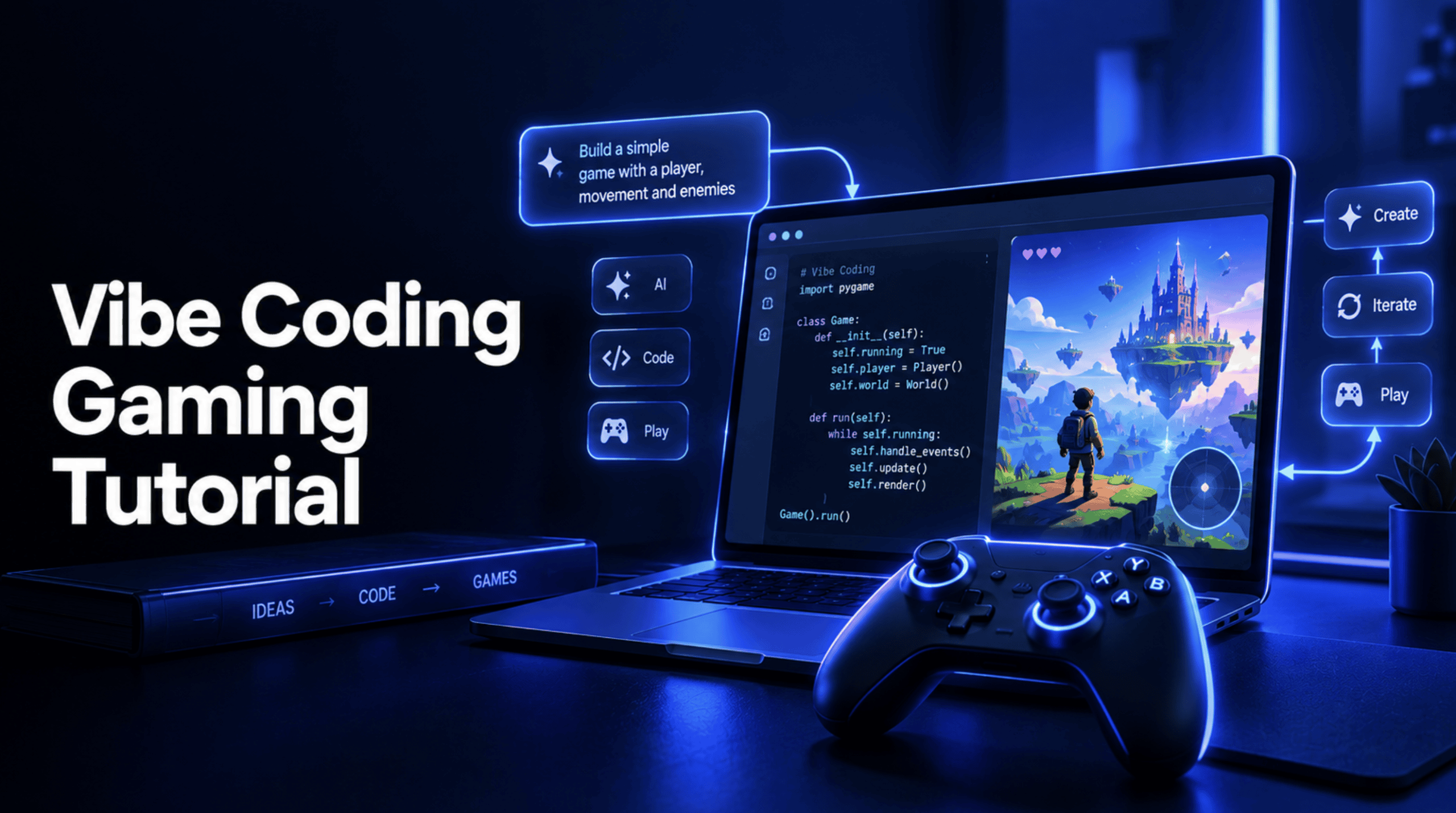
The term is barely a year old in spirit and already institutional. Andrej Karpathy coined “vibe coding” in early 2025 to describe describing what you want in natural language and letting an AI handle the generation, execution and iteration. Collins English Dictionary then named it Word of the Year for 2025, which is roughly the point at which a phrase stops being a joke and starts being a job description.
The tooling has moved with the vocabulary. Autocomplete that suggested a line is now an agent that can read an entire project, edit across multiple files, run the code and fix what breaks from a single natural-language instruction. The scale of adoption is no longer speculative: Airbnb reports that AI now writes around 60% of its new code. If you want a broader picture of how the major assistants diverge once you stop reading feature checklists, our AI Coding Assistants Compared: Cursor, GitHub Copilot, Claude Code, Windsurf and Replit Agent After a Month of Real Work covers that ground in detail.
The historical hook: a game that outran its own factory
Atari released Breakout on 13 May 1976. Nolan Bushnell and Steve Bristow conceived it as a single-player evolution of Pong, and the hardware design was the work of Steve Wozniak, who built it while contracting for Atari around the same period he and Steve Jobs were developing the Apple I.
The engineering story is the part worth remembering. Wozniak’s design was so aggressively minimized in chip count that Atari’s manufacturing line struggled to reproduce it, and the company shipped a version with more components instead. The same year, Wozniak and Jobs founded Apple, and Breakout’s hardware logic influenced parts of the original Apple II.
Fifty years later the lesson inverts neatly. The constraint that produced that design was physical: fewer chips, less cost, a board that had to be built. An AI agent has no such constraint, which is precisely why a disciplined specification matters more, not less.
The rules are the specification
Before any prompting, the walkthrough states the game plainly. A wall of bricks lines the top of the screen. A ball bounces around the play area. The player moves a paddle left and right along the bottom. Hitting a brick destroys it and scores points. If the ball falls past the paddle, the player loses a life. Destroying every brick wins; running out of lives ends the game.
That paragraph is the real first engineering step, and it is easy to skip. An agent given a vague brief will fill the gaps with plausible choices: its own scoring values, its own collision behavior at edges, its own idea of what happens when the last brick disappears. Writing the rules down first converts those choices from surprises into requirements. It also gives you something to test against later, which is the difference between a demo and a deliverable.
Tooling: less than you think
The requirements are a modern browser (Chrome, Firefox or Safari), a text editor and one AI coding assistant. No build tools, no frameworks, no dependencies. The game is a single HTML file that runs when you open it.
For Claude Code specifically, the setup is two commands: install with npm install -g @anthropic-ai/claude-code, then run claude inside an empty project folder. The walkthrough notes that the prompts carry over essentially unchanged to Cursor, Replit or other assistants, so the workflow transfers even if the tool does not. That portability matters, because the interesting variable in agentic coding is increasingly the harness and the habits around it rather than the model alone.
Build in stages, not in one shot
The central recommendation is one capability per prompt. Asking for the entire game at once is possible, but the walkthrough is direct about the cost: it is harder to debug. When something misbehaves in a large single response, you are hunting through code you never watched being written.
Stage one is deliberately boring. The prompt asks for a single HTML file with a 480 × 400 px HTML5 canvas centered on the page, a dark background, a heading, and placeholder score and lives text above the canvas. Skeleton only. No game logic. Stage two adds an 80 × 10 px paddle near the bottom of the canvas.
Each stage should be small enough that a failure has an obvious location. If the canvas does not appear, the problem is in the canvas setup. If the paddle is in the wrong place, it is in the paddle code. The agent’s speed is only an asset if you can still localize its mistakes.
Verification is the part that matters
The walkthrough makes a claim that deserves emphasis: every line of code was written and verified before publication, and the collision physics and win/loss conditions ran through real automated tests.
Generated code that looks right is not the same as code that behaves right, and collision logic is exactly where plausible-looking implementations fail. Ball-to-paddle reflection, brick removal at the wall edges, the transition from losing a life to resetting the ball, the moment the last brick falls and the win condition fires: each is a small state machine that either matches the specification or does not.
Automated tests for a browser game are not exotic. The point is not the specific harness but the posture. The agent is a fast implementer; the specification and the test suite are yours. Once you accept that division of labor, the review burden stops feeling like overhead and starts feeling like the actual job.
Limits of the source and open questions
One honest caveat: the walkthrough is truncated mid-sentence in the second prompt. Later build stages, the tuning of ball speed and paddle response, the scoring values and the final behavior of the finished game are not reported. We know the staging philosophy and the verification standard, but not how the remaining stages were sequenced or how much iteration the physics required.
The most instructive part of any agentic build is usually the middle, where the first implementation meets reality and the prompts get revised. We do not have that record here, so treat the approach as a sound template rather than a fully documented result.
Takeaways for engineers
Three things transfer directly from a 1976 arcade game to whatever you are shipping this quarter.
First, write the specification before you prompt. The Breakout rules fit in a paragraph, and that paragraph is what makes the output testable. Your service contract, your data model, your error semantics: same principle, more consequences.
Second, keep the test harness. The walkthrough’s insistence on automated tests for collision and win/loss conditions is the difference between vibe coding as a demo trick and vibe coding as a production workflow. An agent that can run code and fix breakages is only useful if something tells it, and you, whether the fix worked.
Third, stage complexity so failures stay debuggable. Canvas, then paddle, then ball, then bricks, then scoring. Each step small enough to verify. The temptation with a fast agent is to ask for everything at once because it can. The discipline is to ask for one thing at a time because you have to review it.
Wozniak minimized chips because the factory demanded it. The modern constraint is not compute but confidence: how much generated code can you verify before you ship it. Stage the work, keep the tests, and the agent becomes what it should be, a very fast junior engineer with excellent typing speed and no authority to merge.