
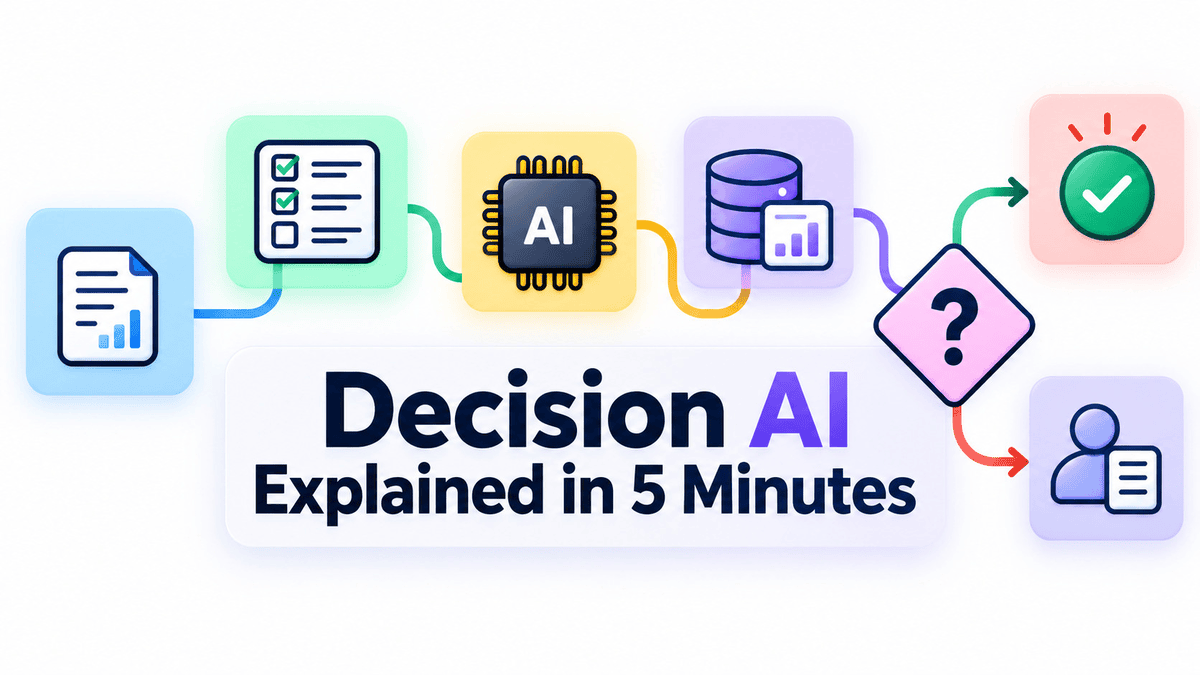
Decision AI: The New Class of Models That Skip Text Generation and Return Probabilities
Most of the AI conversation in 2026 is still about generation. Bigger context windows, faster tokens, better prose. But underneath that noise, a quieter architectural shift has been taking shape: a class of models that does not generate text at all. Instead, it takes a question, a set of predefined answers, and returns a probability for each option. That is it. No paragraph. No explanation. Just a decision, expressed as numbers a downstream system can consume directly.
This is the world of decision models, sometimes grouped under the umbrella of Decision AI. The idea is simple but consequential. If your application already knows the possible answers, why ask a language model to write a sentence that you then have to parse? Why pay for token-by-token generation when a single forward pass can score every option at once?
The proprietary model leading this category is Jev, available through TypeSafe’s API. The open-source ecosystem has already responded with inspectable, fine-tunable alternatives that run locally. For engineers who prefer to own their stack, that matters.
What Decision AI Actually Is
The term needs a sharper definition than the obvious one. Decision AI is not simply “AI that helps make decisions,” which describes most classifiers ever deployed. The distinction that matters is architectural. Classical decision models, from logistic regression to gradient-boosted trees, are trained on a fixed label set. The newer generation of decision models derives its scoring behavior from a language model but constrains the output to a set of candidate answers supplied at inference time, returning a probability for each one.
That difference is what a skeptical reader should press on. Why is scoring logits over candidate answers meaningfully different from ordinary zero-shot classification? Two reasons. First, the option set is not baked into the weights. You define the question and the possible answers at request time, so one model can serve many decision tasks without retraining. Second, a single forward pass can score multiple options, potentially across several questions, rather than running a separate generation for each label. The workflow is remarkably consistent: provide the information, define the question, specify the possible answers, and receive a decision plus probabilities.
It is a different contract between the user and the model. With a chatbot, you ask a question and negotiate with prose. With a decision model, you constrain the output space up front and get back something structured. The model is not trying to be helpful in a conversational sense. It is trying to be precise in a computational sense.
A Concrete Example: Routing a Support Email
Consider a customer email that reads: “I was charged twice for my order.” A decision model classifies this to the billing department with a probability attached. It does not generate an explanatory paragraph. It does not hedge. It returns a structured output that a ticketing system can act on immediately.
That distinction is easy to underestimate until you have built the alternative. With a generative model, you prompt for a classification, then write a parser, then handle the cases where the model adds a friendly sentence before the label, or rephrases the category name, or returns two categories when you wanted one. With a decision model, the output is the decision, which suits applications that process thousands of similar requests: support triage, content moderation, intent detection, document routing.
One caution applies to every figure in this article. The example probabilities here and below, such as a 0.91 score for billing, are illustrative, chosen to show the shape of the output rather than measured results. Before automating anything, test accuracy and probabilities on real data. A probability of 0.91 for the billing department is only useful if you have verified that the model’s 0.91 means what you think it means on your distribution. Calibration is not automatic.
How an LLM Becomes a Decision Model
There are two levels of intervention here, and they are worth separating.
The lighter approach extracts logits, the raw scores a model assigns to possible next tokens, for the predefined answers. Convert those scores to probabilities with softmax and you have a classifier without retraining anything. An illustrative product-review classifier might produce roughly 73% positive and 27% negative; those numbers are hypothetical, not benchmarked. Note that these probabilities are relative to the selected options. They tell you how the model distributes belief across the answers you offered, not how confident it is that the question is answerable at all.
The deeper approach replaces the text-generation layer with a small prediction head and fine-tunes on decision tasks. This enables scoring of multiple options, potentially across several questions, in a single forward pass. Skipping token-by-token generation makes repeated decisions faster and more efficient, which is exactly what you want when the same model is invoked thousands of times per minute.
If you are building this kind of system from scratch, the engineering discipline involved is closer to classical ML deployment than to prompt engineering, and the serving and scaling side is where prototypes tend to stall.
Jev and TypeSafe AI
Jev is the proprietary decision model available through TypeSafe’s API. TypeSafe has shared some details of its approach, but it has not published the full architecture, model weights, or training recipe. That is a familiar posture for a company building a commercial API, and it is not unreasonable. It does, however, mean that teams with data residency requirements, latency constraints, or a preference for auditable systems have limited options if they want to use Jev specifically.
Open-Source Alternatives You Can Inspect
The open-source community has released alternatives that are inspectable, fine-tunable, and locally runnable. Claims of benchmark wins or cheaper inference for these models circulate widely, but they are task-specific and depend heavily on whether you already have hardware, so treat them as hypotheses to test rather than settled results.
Both Ollama and llama.cpp support decision models through a TypeSafe-compatible /v1/systemone endpoint. Ollama supports models such as Nimble and Tev1. llama.cpp supports Laya, Kev, Julia-1, and OpenJev. If you already run a local inference stack, these slot in without a new serving framework.
Running a Decision Model Locally
The tutorial path is straightforward. Using the latest llama.cpp, you start a local server with a model such as Laya and then send a customer support request from another terminal. The model returns the selected department with a probability per option. No paid API is involved.
That last point deserves emphasis. The open decision models are designed to run locally without a paid API, and the tutorial runs one on a local machine. The barrier to experimentation is low enough that you can validate the approach on your own data before committing to any vendor.
Where Decision Models Fit Alongside LLMs
The framing that decision models replace LLMs is wrong. They complement them.
An AI coding agent can use a small decision model to select a tool, decide whether to search the web, or judge whether a task needs a more powerful LLM. That last use case is the most economically interesting. Routing decisions are frequent and cheap to make; reasoning is expensive. Reserving expensive reasoning models for tasks that actually need them changes the cost profile of an agent substantially.
This is the same pattern that has been quietly spreading through production agent stacks: a fast, narrow model handles triage, and a large model handles the hard cases. Decision models make the triage step cheaper and more predictable, because the output is already a probability rather than a sentence you have to interpret.
Decision models are also being tested in games, where they choose the next move in milliseconds. That latency profile is the point. A generative model cannot respond fast enough for many real-time control loops, but a single forward pass over a small set of options can. Robotics has been floated as a further application, but treat that angle as early-stage: the game results are concrete, the embodied claims are directional.
The Quiet Shift Worth Watching
The most interesting thing about decision AI is not any single model. It is the reframing. For two years, the default assumption has been that a language model’s job is to produce language. Decision models challenge that assumption by treating the model as a scorer over a constrained answer space, with all the engineering benefits that follow: structured outputs, single-pass multi-option scoring, lower latency, and a clean separation between the model and the system that consumes its output.
The open-source side of this ecosystem is already shipping locally runnable alternatives, and the compatible endpoint means switching costs are low. Whether Jev remains the reference implementation or the open models overtake it on the tasks you care about is an empirical question. The way to answer it is to run the models on your own data, check the probabilities, and see whether they hold up.
If you are experimenting with these models for text-adjacent tasks, it is worth remembering that the same ecosystem keeps producing strange, narrow, useful tools, from Humanizer, the Open-Source 12B Model That Rewrites AI Text to Fool Detectors to the decision models covered here. The pattern is consistent: small, purpose-built models doing one job well, locally, without a generation layer in the way.
Further reading: 7 Free Books That Teach You to Build AI Systems That Actually Scale covers the serving and scaling side of the transition from prototype to production, and Five Docker Containers That Make a Home AI Lab Actually Work is a reasonable starting point for assembling a local serving layer.
Related: decision models generative case.